Cannabis for Gut Health: How It Supports Digestive Wellness
Cannabis and gut health are closely connected through the body’s endocannabinoid system, especially for people living with IBS and chronic digestive issues.
If you’ve ever dealt with stomach issues, I don’t mean just a little discomfort after overeating, I mean the kind of gut pain that ruins your day.
You know how exhausting life can get. You wake up, and the first thing you wonder isn’t “What do I want for breakfast?” but
“Will my stomach behave today?” And even before you step out of the house, there’s that silent calculation: What if it starts again? What if the pain hits while I’m outside? What if I eat something wrong?
People who’ve never lived with digestive problems often think it’s just acidity or “you worry too much.”
People dealing with IBS or long-term gut problems usually find their stomach taking charge of everything.
It shapes social outings, daily meals, work output, and even levels of self-assurance.
This setup feels much like an inner tyrant at work. That little force keeps signalling how one slip could throw the whole day off track.
That’s the background for why so many people have started looking at cannabis for gut relief.
This growing interest clearly shows how cannabis and gut health have become deeply connected for people struggling with long-term digestive discomfort.
Not because it’s trendy or cool, but because after trying dozens of medications, diets, probiotics, therapy sessions, and lifestyle changes… nothing felt enough.
Cannabis for Gut Health and the Brain Connection
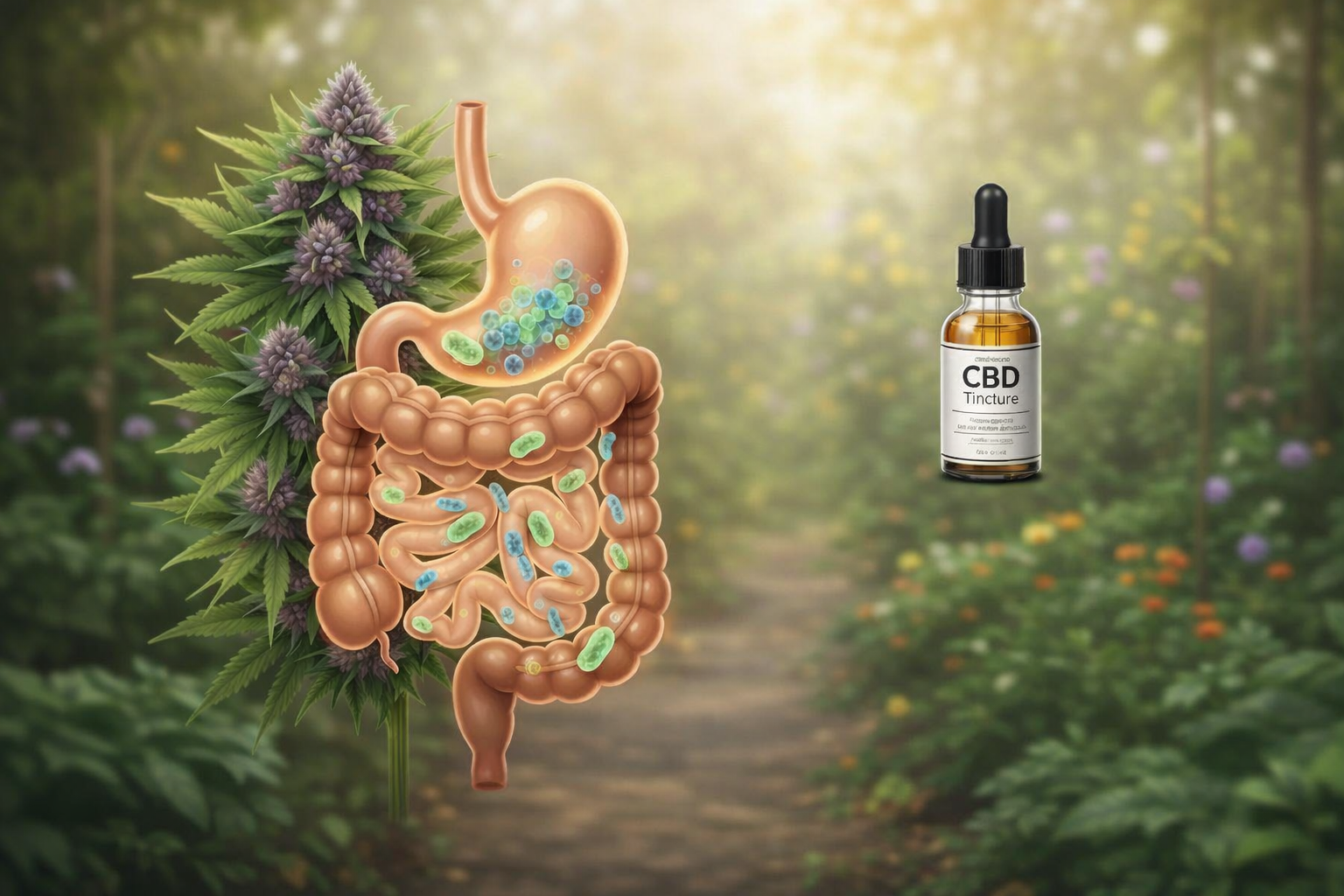
To understand cannabis and gut health properly, it’s important to look at how the gut and brain communicate with each other during stress and chronic pain.
People think digestion is mechanical. You eat, it gets processed, and you poop.
I wish it were that simple.
Your gut is emotional. It reacts to fear, stress, memories, pressure, anxiety, heartbreak, everything. Some call it the “second brain,” but honestly, it sometimes feels like the first one because it controls so much of how we feel.
Inside this relationship between the gut and brain is a system called the Endocannabinoid System, the body’s internal balancing network.
The body already produces substances similar to cannabinoids. So when gut problems show up, and the body isn’t producing enough of these natural compounds… things start spiralling.
That’s where cannabis and gut health comes in, not as an outsider, but almost like reinforcement for a system already trying to work.
How Cannabis for Gut Health Feels in the Body
People expect a dramatic “high” or something mystical. But for those who take cannabis for gut issues, it feels more like this:
- The stomach stops screaming.
- The nerves stop overreacting.
- The cramping relaxes.
- The fear around eating gets quieter.
- You can breathe again.
THC usually eases the intense stabbing pain that strikes without warning.
That kind hits suddenly and leaves someone frozen in place, curled up tight. The stuff calms down those jolt-like shocks right in the stomach. It relaxes the muscles, too, the ones that seize up out of nowhere. On top of that, THC revives appetite in a real way. Nobody fully gets how vital this is when ongoing pain has stolen any urge to eat for days on end.
CBD feels gentler. It doesn’t make you high.
It simply reduces the inflammation that keeps everything in the gut irritated and angry. And it calms the anxiety not mentally, but physically. You suddenly stop worrying about food because your stomach is finally not reacting to everything.
Some people need more THC. Some more CBD. This balance is why cannabis and gut health solutions often work best when personalized rather than treated as a one-size-fits-all approach.
Some need a mix. It’s not about chasing a high. It’s about chasing stability, something gut issues have stolen for too long.
Cannabis for Gut Health in IBS Patients
If you’ve lived with IBS, you know the most painful thing isn’t just the physical pain, it’s the disbelief from others.
Test reports come back “normal.”
Doctors say “everything looks fine.”
People around say, “You worry too much.”
Meanwhile, you’re in pain several days a week. You’re scared to eat outside. You’re scared to be too far from a bathroom. You avoid travel, dates, office lunches, and parties. It doesn’t hurt just your stomach; it hurts your life.
Cannabis and gut health is giving many IBS patients something they hadn’t felt in a very long time: control. Not a cure, but control. Enough calm in the gut to let life happen again without overthinking every meal.
Breaking the Stress Loop with Cannabis for Gut Health
If you know, you know.
Stress triggers gut issues.
Gut issues trigger stress.
And this loop continues until you can’t tell whether the pain is physical or emotional anymore.
Cannabis and gut health breaks that loop for some people. Not dramatically and not instantly, but gently. You stop constantly monitoring your body. You eat something and don’t immediately fear consequences. You sleep without stomach pain waking you up. Your brain stops predicting disaster every time you leave the house.
And that peace, that ability to relax again, is healing in itself.
Cannabis for Gut Health: Relief Without a Cure
Let’s be honest: cannabis doesn’t fix everything.
It doesn’t reverse the disease.
It doesn’t rewrite DNA.
It’s not a miracle cure.
But relief matters. Comfort matters. The ability to live without fear matters.
Sometimes healing doesn’t mean “disease cured.” Sometimes healing means:
- You can enjoy a meal again.
- You can go out without packing anxiety.
- You don’t plan your whole day around the bathroom.
- You stop feeling trapped inside your own body.
That kind of healing is priceless.
How People Use It (Not the Textbook Explanation)
People figure out their own way:
Some put a few drops of oil under the tongue before bed
because mornings are usually the hardest.
Some take a small edible when the pain becomes unbearable.
Some keep a vape for emergencies for those sudden nausea or cramping attacks that come out of nowhere.
It’s personal. And it takes learning and patience. But almost everyone who finds their right dose says the same thing: “I got my life back.”
Cannabis for Gut Health: Safety and Caution
Cannabis use proves unsuitable for every individual. Evidence indicates that some people develop significant anxiety from excessive THC intake.
Others encounter drowsiness or vertigo, along with cognitive impairment resembling a haze, particularly when the dose exceeds expectations. Pregnant individuals, as well as those with particular mental health conditions, must exercise considerable care. Beginning with minimal amounts gradually emerges as essential, not just advisable, for ensuring safety.
Many users report that the benefits substantially outweigh potential mild adverse effects.
The Bottom Line: Relief Is Also a Form of Healing
When discussing cannabis and gut health, relief itself becomes a meaningful form of healing for people living with daily digestive struggles.
Folks without those gut troubles often miss the real weight of it all. They do not see how routine things like eating a meal or walking out the door can turn into total mental fatigue. Sitting through some work meeting drains energy fast, too. Even mapping out a basic day ahead feels overwhelming after a while.
The brain keeps working overtime to deal with the body like that. It holds out hope for one of those better moments. Still, the body does not always cooperate. People just bear the discomfort in silence then. Sharing the details with anyone else comes across as even more draining than going through it alone.
Cannabis doesn’t promise perfection. It doesn’t promise a cure.
What it offers is a pause, a moment where the noise inside your body softens. A break from pain, from panic, from unpredictability.
And sometimes, that break means more than any medical term ever could.
If cannabis and gut health helps someone eat without fear, sleep without pain, step out of their home without scanning for the nearest bathroom, or simply laugh without holding their stomach, that is healing. Maybe not in the clinical sense, but in the human sense. In the sense that life becomes livable again.
And anyone who has lived with gut issues, anyone who has lost days, opportunities, joy, or peace to their own digestive system deserves that kind of healing. Deserves to breathe easier. Deserves to feel normal again, even if just for a while.